
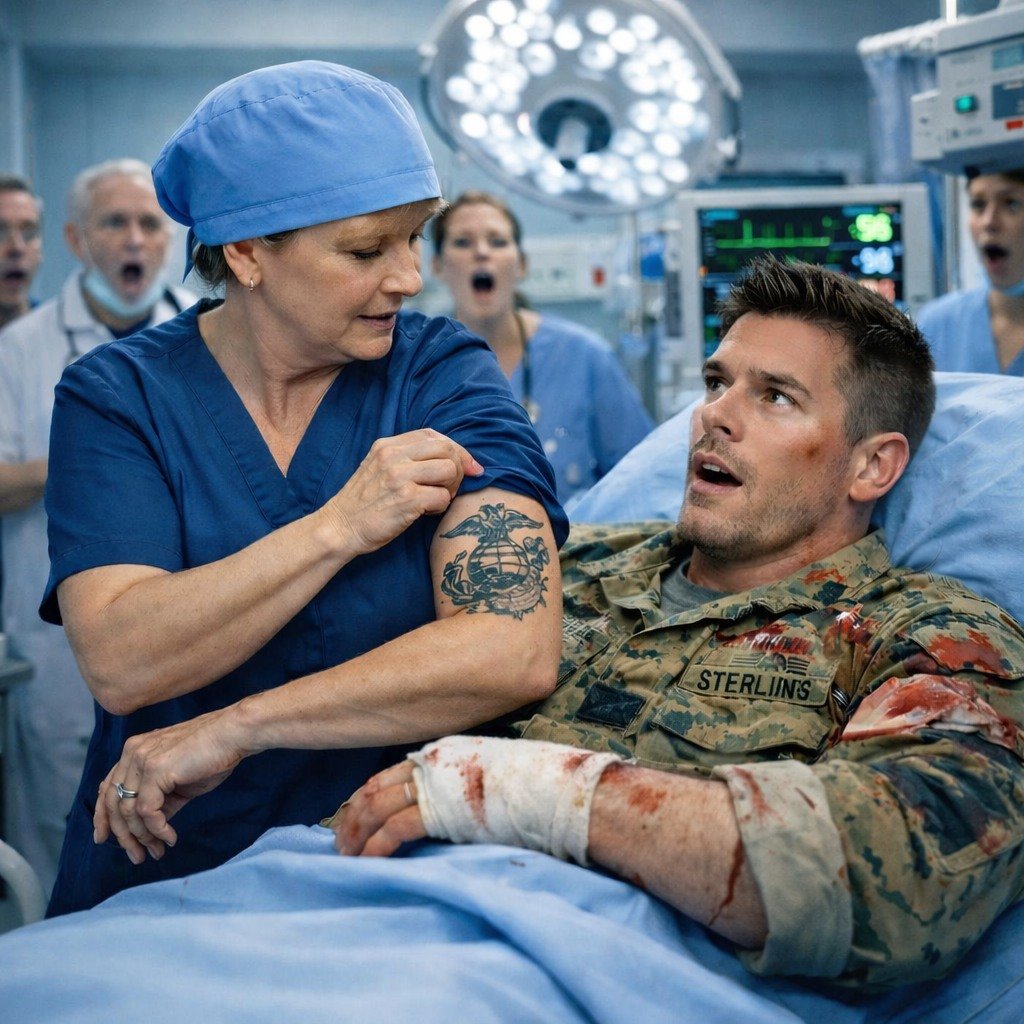
Sarah didn’t answer immediately. She rolled the sleeve up one inch further. There was a scar there, a jagged, ugly pucker of flesh that looked like a deep crater.
“I wasn’t just attached, Colonel,” Sarah said, her voice dropping to a whisper that carried the weight of a thousand graves. “I was the lead surgical nurse for Bravo Surgical Company, deployed to the Hell House. We didn’t just fix you; we scraped you off the pavement.”
She took a step closer to him, pointing a finger at his chest.
“And when your Sergeant Major—Gunny Miller back then—came in with his legs severed at the knees, I didn’t wait for a doctor. I tourniqueted him with my own bootlaces because we ran out of CATs. So don’t you dare sit there and tell me I don’t know the smell of diesel and blood.
I still wash it out of my hair every night.”
Sterling sat frozen, the IV drip the only sound in the room. The twist was not just that she had served; it was that she had served in the very hell he had built his reputation on. “Miller,” Sterling whispered.
“You saved Gunny Miller.”
“He died,” Sarah said flatly. “He died holding my hand, asking me to tell his wife he loved her. I was the last thing he saw.
Not a Marine. Me. A civilian in scrubs.”
The silence that followed was deafening.
It was heavier than the Kevlar vests Sterling used to wear. The hum of the computer fan seemed to disappear, swallowed by the vacuum of the revelation. Sterling stared at the ink on Sarah’s arm—the map of the Jolan district, the kill zone where the 3rd Battalion, 5th Marines, had bled for every inch of dust.
He looked up from the tattoo to her face. The lines around her eyes, which he had dismissed as signs of a tired, middle-aged housewife, now looked like something else entirely. They were etchings of sorrow.
They were the marks of a witness. “You’re the angel,” Sterling whispered, the realization hitting him like a physical blow. “The Angel of Jolan.”
It was a myth he had heard when he was a young Captain.
The grunts spoke of a Navy Nurse at the Forward Resuscitative Surgical System (FRSS), a mobile trauma unit that moved with the front lines. They said she refused to wear a flak jacket while operating because it restricted her movement. They said she had blood up to her elbows for three weeks straight.
They said she hummed lullabies to Marines as they bled out when the morphine ran dry. Sarah pulled her sleeve down slowly, covering the map, covering the skull, covering the history. “I hate that name,” she said softly.
“There are no angels in war, Colonel. Only ghosts and survivors.”
“I thought you were a myth,” Sterling said, his voice raspy. “We heard the FRSS took a direct hit.
Mortars. They said the medical team was wiped out.”
“Most were,” Sarah said, turning back to the computer, though her hands were trembling slightly. “It was November 12th.
We were set up in an abandoned schoolhouse. They walked the mortars in from the north.”
Continue reading…
