
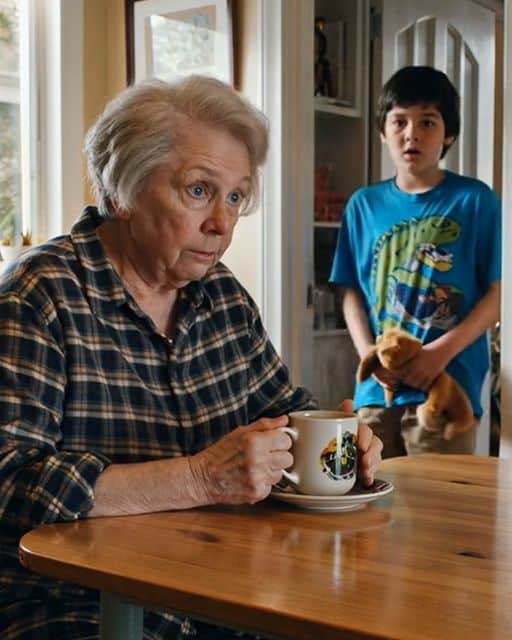
“She won’t,” Damian said quickly. “I know how to pretend. I’ve been doing it my whole life. But now we can work together, Grandma. We can stop her.”
I knelt to clean up the broken mug, hands trembling as tea soaked into an old dish towel. One clear thought cut through the shock.
The next seven days weren’t going to be a simple week of babysitting.
They were going to be a fight for our lives.
The next morning dawned bright and cold. Sunlight poured through my kitchen windows, turning the hardwood floors into wide strips of gold.
For the first time in nearly two years, I could feel my thoughts moving clearly, without the cottony haze that had become my unwelcome companion. The absence of Nyla’s tea felt like emerging from underwater, finally able to take a full breath.
At breakfast, Damian sat across from me at the table, legs swinging, spoon clinking against his cereal bowl. His voice still held that edge of wonder every time he used it.
“Grandma,” he said, lowering his voice even though we were alone, “I need to show you something. But we have to be really careful.”
“What kind of something?”
“Mom’s research,” he said. “She printed some things and hid them in my room. She thought I couldn’t read them, so she figured it was the safest place.”
We carried our dishes to the sink, then headed upstairs.
Damian’s room in my house was really just the small guest room at the end of the hall. I’d decorated it with dinosaur wallpaper when he was four, hoping it might coax him out of his shell. Bright green and blue creatures marched along the walls above his twin bed, grinning their prehistoric smiles.
Now, standing in that cheerful little room, those dinosaurs felt less like friendly cartoon characters and more like silent witnesses.
Damian went straight to the dresser and pulled open the bottom drawer. He moved aside folded shirts and socks. Beneath them, wrapped in an old receiving blanket printed with tiny stars, was a worn manila folder.
He lifted it with both hands and handed it to me like it was something fragile.
“She checks on it sometimes,” he whispered. “She thinks I like the blanket because it’s soft. But really I’m making sure she doesn’t move the papers.”
I sat on the edge of the bed and opened the folder.
The first page made my blood run cold. A printout from a medical website. The title read: Signs of Natural Cognitive Decline in Older Adults.
Passages were highlighted in bright yellow marker: progressive memory loss; increased confusion and disorientation; changes in sleep patterns and appetite; difficulty with complex tasks.
Every highlighted line described what I’d been going through.
Continue reading…
