
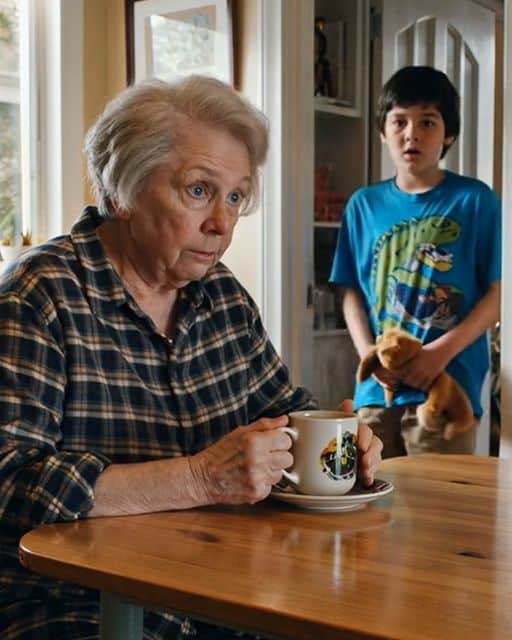
“When I was five,” he said, “I forgot to pretend at the doctor and I said ‘Mama’ out loud. Later she told me if I ever talked again when I wasn’t supposed to, she’d send me away to a special place where kids like me go. She said I’d never see you or Dad again. She said even if I told anyone what she did, nobody would believe me.”
My heart broke and burned at the same time.
“You were five,” I whispered.
“I know,” he said, almost matter-of-fact. “So I learned to be quiet. I learned to read from TV and labels. I watched how grown-ups talk when they think kids aren’t listening.”
By the time we finished, my notebook was filled with dates, patterns, details that looked small until you lined them up and saw what they formed.
That night, as I tucked him under his dinosaur quilt, he looked up at me.
“What’s going to happen to me after we stop her?” he asked. “If she goes to prison…where do I go?”
It was the question that had been gnawing at me since the moment he warned me about the tea.
“I don’t know exactly yet,” I admitted, because he deserved the truth. “But I promise you this: whatever happens, I will fight with everything I have to keep you safe. I will never let anyone hurt you again. And I will never let anyone force you to be silent again.”
He nodded, swallowing.
“Two more days,” he said softly.
Two more days until Dean and Nyla came home expecting to find me sliding toward the edge.
Two more days to get ready.
The next morning, I went to Dr. Reeves’s office. The waiting room smelled like disinfectant and coffee. A television chirped on about something light and stupid, as if there weren’t people sitting there whose lives were about to split in half.
When Dr. Reeves closed the exam room door behind her, her expression turned serious.
“Tell me,” she said.
“I think someone’s been slipping medication into my drinks,” I said. “For a long time. And I think the amount changed this week.”
Her face went still.
“Who?” she asked.
“I’ll tell you everything,” I said. “But first I need proof.”
She nodded once.
“We’ll run a full panel,” she said. “Blood and urine screens for sedatives, sleep aids, and anything else that shouldn’t be there.”
She drew my blood herself. Her jaw was tight. When she finished, she looked me dead in the eye.
“We’ll rush this,” she said. “And Lucinda—if you feel suddenly worse, dizzy, short of breath, call 911. Don’t drive yourself anywhere.”
“I understand,” I said.
When I got home, Damian was waiting at the front window like a little sentry.
“We’ll know soon,” I told him.
That night, we hid the recorder behind a row of cookbooks in the kitchen. A tiny red light winked to show it was on. By sundown, my nerves felt like frayed wire.
At eight o’clock sharp, the phone rang.
Continue reading…
