
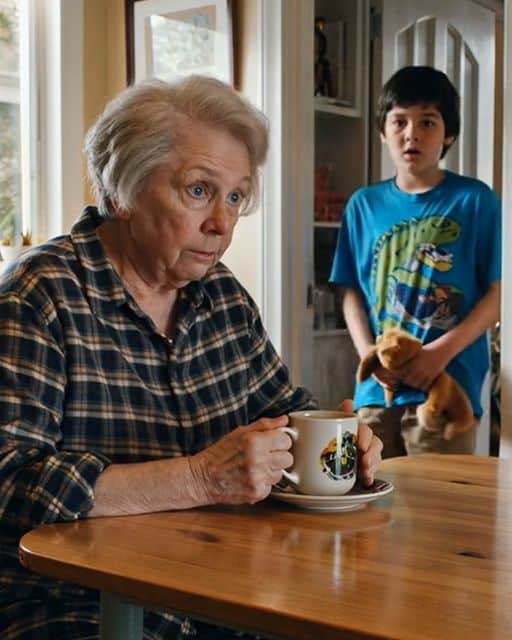
Damian went still on the rug.
I picked up, letting a faint tremor into my voice.
“Hello?”
“Lucinda,” Nyla’s voice was smooth, warm, concerned in all the right places. “How are you and Damian doing? We’ve been thinking about you.”
“Oh…hello, dear,” I replied, dragging my words just slightly. “We’re all right, I think. I’ve been feeling very tired. More than usual.”
“Oh no,” she said, and underneath the concern I caught it—a note of satisfaction. “Have you been drinking the tea I left you? It should help.”
“Yes,” I lied. “It tastes a bit stronger than usual… but you always know best.”
A pause.
“Stronger?” she repeated.
“Mmm,” I murmured. “But it helps me sleep.”
I could practically hear her calculating.
“How’s your appetite?” she asked.
“Not very good,” I said. “And I lose track of time. This morning I found the remote in the refrigerator. I don’t remember putting it there.”
“That can happen at your age,” Nyla said softly. “But it does make me think… when we get back, we should talk about getting you more help. Maybe part-time at first.”
Help. A stranger in my house. A pathway to “care.” To “alternative arrangements.”
“Whatever you think is best,” I said faintly. “I don’t want to be a burden.”
“You’re not a burden,” she said quickly, and then, “But sometimes professional care is the kindest option—for everyone.”
My grip tightened.
She asked about Damian like he was an inconvenience to manage.
“He’s been very quiet,” I said, looking at him. “More withdrawn. He watches me a lot.”
“That’s probably best,” Nyla said. “Less stimulation for you. Just make sure he stays out of your way.”
Then came the part that turned my blood cold.
“If you start feeling worse—dizzy, short of breath, confused—don’t try to go anywhere,” she said gently. “Don’t drive. Just lie down and rest. Sometimes the best thing for someone your age is to let your body recover. Nature knows what it’s doing.”
I felt the October air even inside my kitchen.
“Of course,” I said. “You’re very thoughtful.”
“That’s what family is for,” she replied.
After a few more pointless minutes, she hung up.
I stood there, phone in my hand, heart pounding.
“You did great,” Damian said quietly.
“You think she bought it?”
He nodded. “Her voice goes higher when she’s really happy. She sounded really happy.”
The next morning, Dr. Reeves called.
Her voice had none of its usual lightness.
“Lucinda, the lab work shows high levels of medications that aren’t on your chart,” she said. “A mix of strong sleep medicines and calming agents. Enough, over time, to affect thinking and memory.”
I sat down hard at the kitchen table.
“So I’m not imagining it.”
“No,” she said. “And Lucinda—if those levels had kept increasing, this could have become life-threatening.”
“What do I do?”
“I’m obligated to tell you that you should contact law enforcement,” she said. “If you want, I’ll support it and document everything—including your improvement since the suspected exposure stopped.”
I thanked her and hung up.
Damian watched me from the doorway, steady and pale all at once.
“She found it,” he said.
“She did,” I answered. “It’s real.”
He nodded toward the recorder.
“Then we’re ready,” he said. “For when they get back.”
The day Dean and Nyla were due home felt like the quiet before a storm.
We did one last run-through that morning.
“You’re tired,” Damian reminded me. “Confused, but not totally gone. If you act too different, she’ll know.”
“And you?”
He shrugged, like he was putting on a coat he hated.
“I go back to being the quiet kid,” he said. “I stare at the floor. I rock a little. I don’t answer.”
I hated it, but we both knew it was temporary. A mask for survival.
We hid the recorder in the living room behind a stack of paperbacks and turned it on.
At two-thirty, I heard Dean’s car in the driveway. I settled into my armchair and wrapped an afghan around my shoulders, softened my posture until I looked smaller. Damian sat on the rug near my feet, toys scattered, body still and eyes alert.
The door opened.
“Mom?” Dean called. “We’re back!”
“In here,” I answered, letting my voice come out thin.
They stepped into the living room.
Nyla took one look at me and paused. For a blink—before she rearranged her expression—I saw it: satisfaction.
Then she rushed forward, all concern.
“Oh my goodness, Lucinda,” she said. “You look exhausted. Have you been feeling okay?”
Dean hovered in the doorway, duffel bag on his shoulder, tan from the cruise making the dark circles under his eyes look worse.
“Mom,” he said carefully, “you do look…different.”
“I’ve been having trouble,” I murmured. “The tea helped some. But I’ve been so tired.”
Nyla’s eyes flicked with quick calculation.
“You’ve been drinking it just like I told you, right?” she asked. “All of it?”
“Oh yes,” I said, forcing myself not to glance toward the trash. “Every morning and night.”
A tiny pleased exhale.
“Good,” she said. “Consistency matters.”
Dean sat across from me. “Have you talked to Dr. Reeves?”
Nyla cut in smoothly. “Dr. Reeves might not be the right one anymore. This might need a specialist. Someone who handles advanced memory decline.”
Advanced. The word landed heavy.
I let my gaze drift, then brought it back with slow trust.
“You’ve taken such good care of me,” I said softly. “You always know what to put in that tea.”
Something sharpened in her face.
“Have you been calmer?” she asked. “Sleepier?”
“Very sleepy,” I murmured. “Sometimes I wake up and I don’t know what day it is.”
Her lips twitched.
“That happens,” she said. “But we’ll take care of you.”
Then she turned to Damian.
“And how has he been?” she asked briskly. “Any outbursts?”
Damian stared at his toy and rocked faintly.
“He’s been quiet,” I said.
“Good,” Nyla said. “The less stimulation you have, the better.”
I decided it was time.
“Damian,” I said, touching his shoulder, “could you get Grandma a glass of water? I’m dizzy.”
We had rehearsed it. He rose, but instead of going to the kitchen, he walked to the bookshelf.
“Damian, the kitchen is that way,” Nyla snapped, pointing.
He ignored her.
He reached behind the books and pulled out the recorder.
He turned and faced them.
“It’s not for water,” he said, voice clear and steady. “It’s a recorder. I’ve been recording everything—especially what Mom says about Grandma’s tea.”
The room went dead silent.
Nyla went pale.
Dean’s mouth fell open.
“That’s…that’s impossible,” Nyla stammered. “He doesn’t talk.”
“I can talk,” Damian said. “I always could. You just scared me so much I had to pretend.”
Dean stared at his son like a man waking up.
“Damian?” he whispered. “Buddy…how long…?”
“My whole life,” Damian said. He moved closer to my chair. “Mom told me if I ever spoke when I wasn’t supposed to, she’d send me away and hurt Grandma.”
Nyla snapped toward me.
“What is this?” she demanded. “What are you doing?”
I straightened in my chair and let the fog fall away.
“I stopped drinking your tea five days ago,” I said calmly. “My doctor ran tests. She found strong sedatives and calming agents in my blood—medications I was never prescribed. She documented my improvement when they stopped.”
“You’re confused,” Nyla spat. “You’re having an episode—”
“Am I?” I said, and reached for the folder on the side table.
I opened it like I was opening a door.
“This looks pretty clear to me.”
I read her notes out loud—dates, observations, and the lines that mattered most.
“‘Subject must be gone before next financial review.’ ‘Prepared stronger packets for cruise week.’ ‘Permanent solution within 48–72 hours.’”
Dean went gray.
“What is she talking about?” he whispered.
“She’s talking about how Mom’s been hurting Grandma,” Damian said, voice steady. “And how this week was supposed to finish it.”
Nyla’s composure cracked.
“You have no proof,” she hissed. “No one will believe a confused old woman and a—”
“A child who can speak in full sentences, read, and testify to what he’s seen,” I cut in. “We have lab results. We have your handwriting. We have your research. And we have recordings.”
I pulled my phone from my pocket.
“Lucinda, don’t,” Dean said, panic rising.
“She tried to kill me,” I said, quiet and certain. “And she used your son as a shield.”
Nyla lunged—not at me, but at Damian.
“Give me that!” she shouted, reaching for the recorder.
I moved faster than I had in years, stepping between them.
“Don’t you dare touch him,” I said, so sharp she stopped mid-motion.
Damian slipped behind me, clutching the recorder.
Dean grabbed Nyla’s arm, his grip shaking.
“Stop,” he said hoarsely. “Just…stop.”
Outside, faint at first, rose the distant wail of a siren.
I finished dialing and pressed the phone to my ear.
For the first time in two years, I felt like help was actually on its way.
Nine months later, Ohio sunshine slanted through my kitchen windows, but everything else about my life felt different.
The air smelled like sugar and vanilla. Damian stood on a stool beside me at the counter, carefully rolling out cookie dough with a wooden rolling pin almost as big as his forearm.
“Can I add the vanilla now, Grandma?” he asked.
His voice—his wonderful, steady, endlessly curious voice—still felt like a gift every time I heard it.
“Go ahead,” I said. “Just don’t pour the whole bottle.”
He grinned and measured out a careful teaspoon.
The months after that afternoon in my living room had been hard and healing in equal measure.
Once law enforcement saw the evidence, the legal process moved quickly. Dr. Reeves’s reports documented the medications in my system and my sharp improvement when they stopped. Nyla’s folder painted a picture of intent. Her progress notes read like an experiment. And the recorder captured what mattered: her satisfaction, her instructions, her careful nudges to keep me from seeking help.
Most powerful of all, though, was Damian.
After child psychologists evaluated him, it became obvious he wasn’t incapable of communication—he was unusually bright. Years of forced silence hadn’t dulled him. If anything, it had sharpened him.
In court, he sat straight in a collared shirt and answered questions in a calm voice that silenced every whisper about “limitations.” He explained how his mother forced him to pretend. He explained the threats. He explained what he’d seen.
The defense tried to argue confusion, misunderstanding, coincidence. But the jury watched Damian. They listened to my doctor. They read Nyla’s handwriting.
In the end, Nyla was convicted of attempted murder, mistreatment of an older adult, and endangering a child. She was sentenced to fifteen years in a state prison, with strict limits on contact with Damian.
Dean’s situation was complicated. At first there was talk of charging him, but as the investigation unfolded it became clear he had failed to act—terribly—while also being manipulated and pressured. When the truth broke open, he cooperated fully. He testified. He handed over what he had. He accepted a plea deal: probation, mandatory counseling, and court-ordered education focused on recognizing and preventing abuse.
Most importantly, he voluntarily gave up full custody.
“I failed him,” he told the judge, voice breaking. “My mother didn’t.”
The court granted me guardianship.
That’s how I ended up here, nine months later, watching my grandson lick cookie dough off a spoon like he’d never been afraid to be a child.
“The doctor at school says I might catch up by next year,” Damian said as we slid the cookies into the oven. “She says I’m ahead in some things already.”
“I’m not surprised,” I told him. “You protected both of us for years. A little extra schoolwork is nothing compared to that.”
Without Nyla’s constant pressure, Damian blossomed. He talked. He laughed. He asked a hundred questions a day. He devoured books like they were candy. He also met regularly with Dr. Martinez, a child psychologist in town—therapy for him, and for us together.
“You were being harmed too,” Dr. Martinez told me gently once. “It’s hard to protect someone else while you’re being slowly poisoned and manipulated. What matters now is that you’re both safe and you’re healing.”
There were medical bills and therapy bills and legal fees. Ironically, the life insurance policy Nyla had been so eager to cash in on became part of what helped fund our recovery, redirected with my lawyer’s help into Damian’s care and education.
I updated my will, too. Not with vague assumptions, but with clear instructions. My modest home—fully paid off, the same home Nyla had seen as a prize—was firmly designated for Damian when he was grown. If something happened to me before then, there were safeguards in place. No one was going to slide paperwork across a desk and call it “what’s best” ever again.
One afternoon, a neighbor called across the fence, smiling at Damian as he proudly showed off a science project.
“You look more like yourself every day, Lucinda,” she said. “And that boy—he’s a whole new kid.”
“We’re doing better,” I called back. “Much better.”
That evening, my lawyer phoned to tell me Nyla’s appeal had been denied.
Her sentence stood.
Later, on the front porch, Damian curled beside me with a book, and after a while he asked quietly, “Do you ever think about her?”
“Sometimes,” I admitted. “Do you?”
“Not as much,” he said. “Dr. Martinez says my brain used to expect her to show up again, even when she couldn’t. But that feeling goes away when you feel safe for a long time.”
I watched the sun sink behind the trees, the porch light clicking on as dusk deepened.
“What do you want to be when you grow up?” I asked.
“A doctor,” he said without hesitation. “For kids who don’t talk because they’re scared. I want to help them find their voices.”
My throat tightened.
“That’s a beautiful dream,” I said. “And I think you’ll be very good at it.”
“Will you help me study?” he asked.
“For as long as I’m able,” I promised. “And even after that, I’ve made sure you’ll have what you need.”
Later, after homework and dinner and the familiar routines that now felt like comfort instead of control, I tucked him into bed and smoothed his hair back.
“I love you, Grandma,” he said.
“I love you too,” I whispered.
He hesitated in that way children do when they’re brave but still small.
“Do you think we’re really safe now?” he asked. “Like…for real?”
I thought about courtrooms and records and locked doors. I thought about my body growing stronger the farther I got from those hidden drugs. I thought about Damian’s voice filling the house like sunlight.
“I think we’re as safe as anyone can be,” I said. “But more importantly, we know what danger looks like now. We know how to speak up. We know our voices matter.”
He nodded, satisfied.
“No more nightmares,” he murmured, eyes closing. “Dr. Martinez says nightmares go away when you feel really safe.”
I kissed his forehead and turned off the light.
For a moment I stood in the doorway listening to his steady breathing—peaceful, unforced, real.
Then I went back to the kitchen, made myself a cup of herbal tea I prepared with my own hands, and sat with a notebook.
Not to plead to the world, not to perform pain, not to beg to be believed.
Just to put the truth somewhere solid.
Because the day my grandson looked at me and said, clear as anything, “Grandma, don’t drink that tea,” wasn’t the day our lives ended.
It was the day they began again.
